Introduction
EBCS is entering an exciting new chapter in coaching, and this document is part of that journey.
This booklet introduces the new Level 1 coaching practices and gives you a clear, shared approach to bring to your club—one that empowers you to coach with confidence, consistency, and purpose.
We encourage you to build on these foundations with your own coaching strengths, helping bowlers grow through purposeful practice that transforms sound technique into confident, consistent performance.
This guide is designed as an update for qualified coaches. It is not intended to replace formal training or serve as a complete coaching manual; instead, it offers a practical framework you can take straight onto the rink and use with assurance from day one. Going forward, all new Level 1 coaches will be trained in these practices, helping to establish a consistent and confident approach from the very start.
Every element has been shaped by experienced coaches and leading bowlers, then tested and refined with players over several seasons. The result is a simple, repeatable approach that helps bowlers progress faster, play with greater belief, and enjoy the game more deeply.
Most importantly, it gives every bowler a strong foundation in grip, line, length, and routine. When everyone begins from the same solid base, coaching becomes clearer, progress becomes easier to see, and future development can be built with confidence by the coach, the club, and the individual alike.
Booklet at a Glance
- Bowler Assessment: A simple session to help a coach assess a new bowler.
- Grip and Bowl: Help new bowlers choose a suitable bowl, learn the basic grip, understand the bias, and deliver with control.
- The Aeroplane Method: Teach a clear four-stage delivery routine—Pre-Flight, Taxiing, Take-Off and Landing—to improve consistency.
- Line Coaching: Establish a repeatable line on each hand and learn how to adjust the aiming point for different targets.
- Length Control: Improve weight control using a natural bowl, followed by the Step and Clock adjustments, and finishing with Caterpillar practice.
- Jack Delivery: Apply the same line-and-length routine to jack delivery and practise short, medium and long jacks consistently.
Please note graphics are intended as reminders and are not to be considered accurate depiction of style etc
1. Bowler Assessment
Aim
To make a quick initial assessment of the bowler.
Set-up
- Check rink/footwear/space.
- Explain session aim and how it will run.
Warm-up
- Walk the rink and do a few gentle bends.
- Pick up and place the jack a few times.
Activity
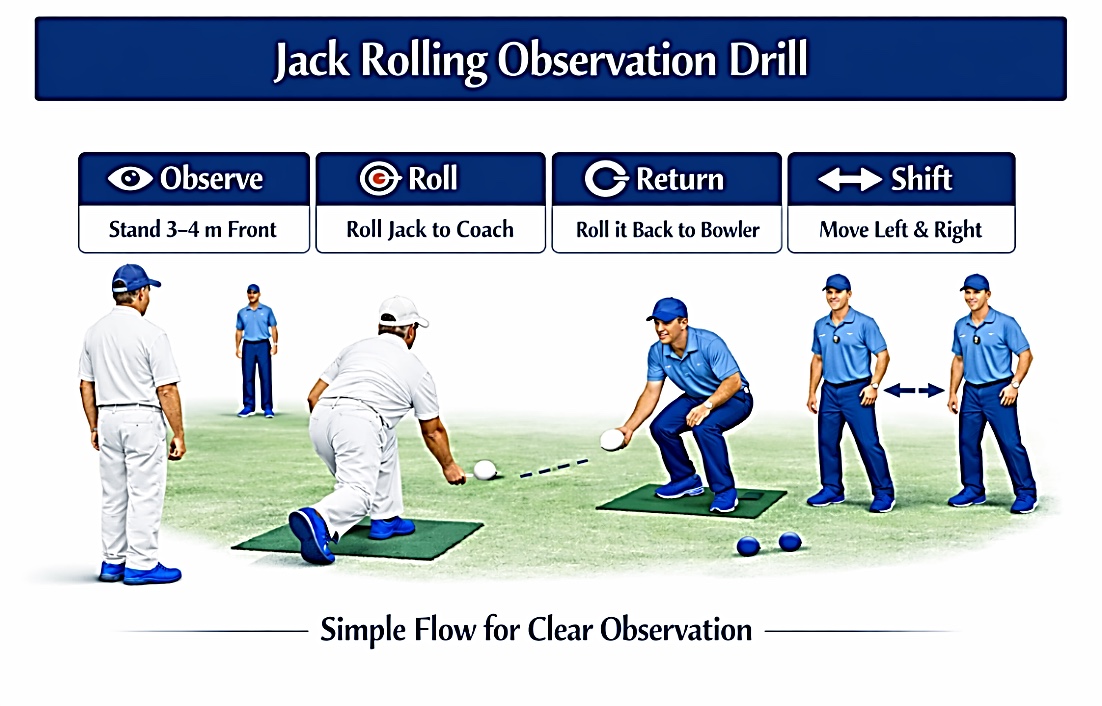
- Ask the bowler to stand on the mat with a jack in hand.
- Stand approximately 1 to 3 metres directly in front of the bowler.
- Ask the bowler to roll the jack to you, then roll it back to them.
- Begin from the centre, then move to the left and right, repeating the practice from each position.
Assessment
By the end of the session, the coach should be able to identify the main areas that may need attention in future coaching.
- Are they left- or right-handed?
- Do they have any difficulty bending?
- Do they have any difficulty stepping smoothly?
- Do they understand how to turn and face you correctly?
2. Grip and Bowl
Aim
To help players choose a suitable bowl and learn a basic, consistent grip.
Set-up
- Check safe footwear and clear space.
- Have a selection of bowls available for the bowler to choose from.
Warm-up
- Quick arm/wrist mobility and pass a bowl to feel the weight.
Activity
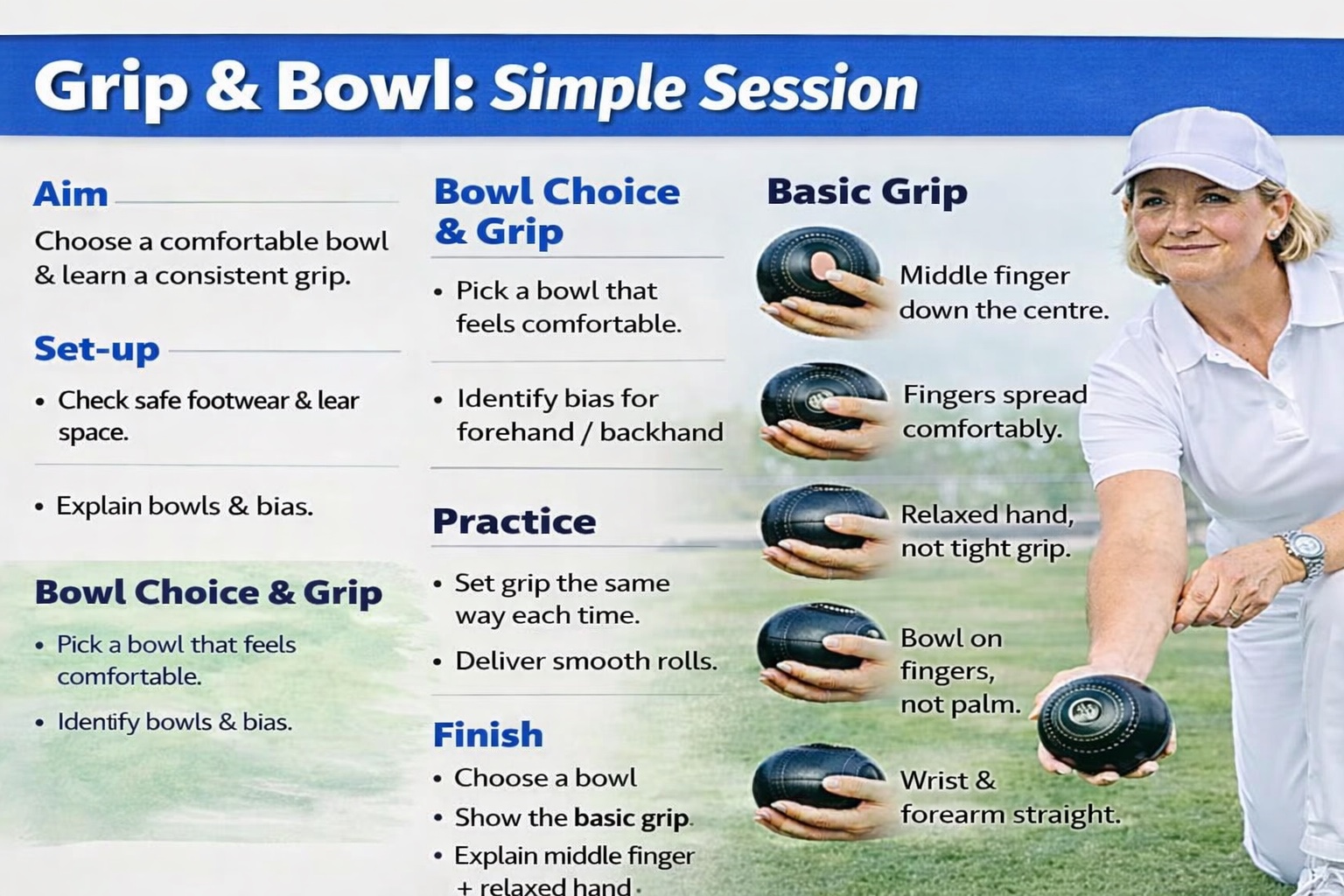
- Allow each player to choose a bowl that feels comfortable and manageable in the hand.
- Show how to identify the bias and set the bowl correctly for forehand or backhand delivery.
Basic Grip
- Place the middle finger down the centre of the bowl.
- Spread the fingers comfortably around the bowl.
- Keep the hand relaxed and avoid gripping too tightly.
- Support the bowl with the fingers rather than allowing it to sit in the palm.
- Keep the wrist and forearm in a straight line.
- Practise picking up the bowl and setting the grip in the same way each time.
- Deliver bowls with a smooth, controlled roll until the action becomes comfortable and repeatable.
Finish
By the end of the session, players can:
- Choose a comfortable bowl.
- Demonstrate the basic grip.
- Explain the importance of correct finger position and maintaining a relaxed hand.
3. Aeroplane Method
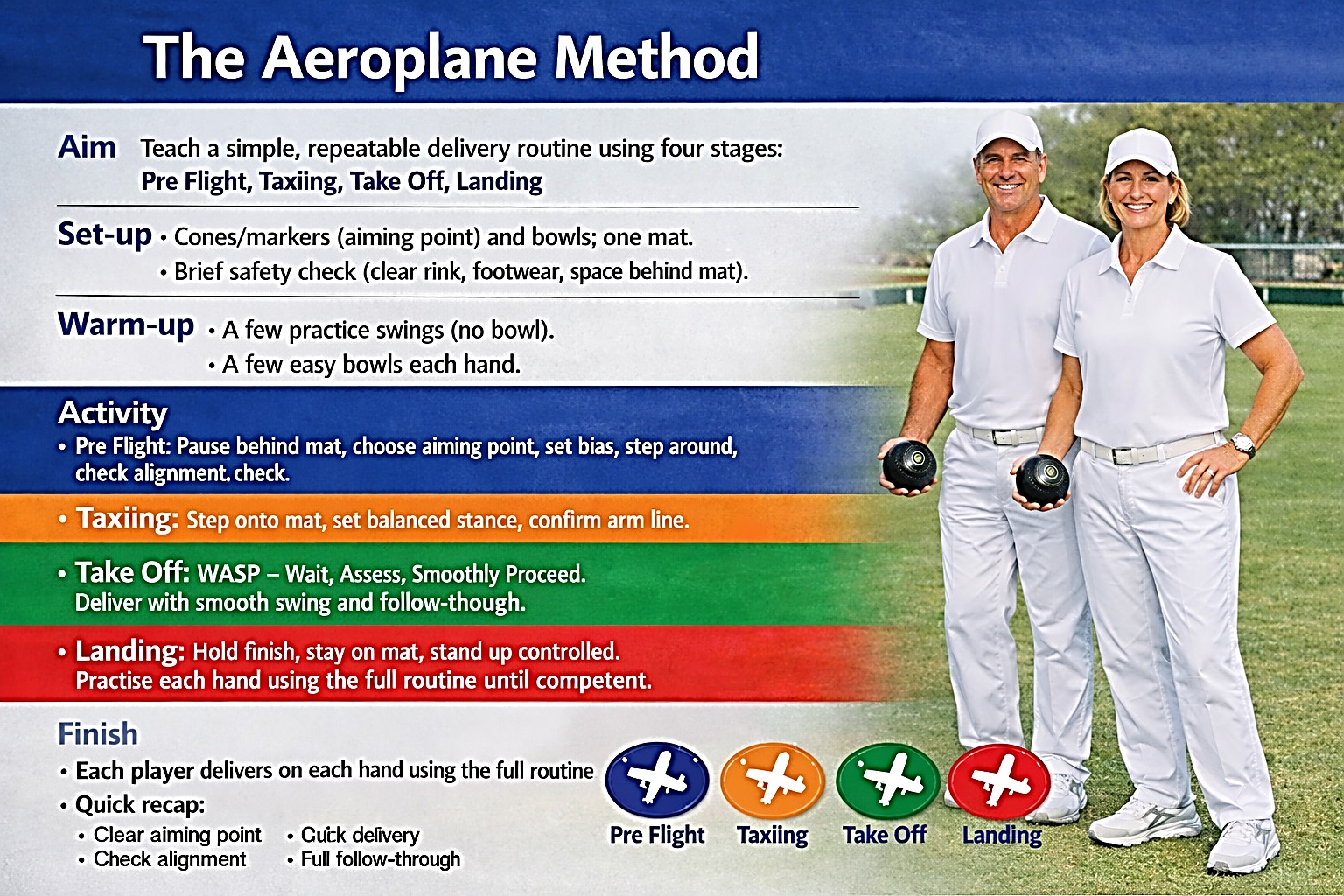
The Aeroplane Method uses the stages of a flight as a simple way to explain the bowling delivery. Just as a pilot prepares, lines up, takes off and lands under control, the bowler follows a calm routine to prepare, align, deliver and finish in balance. This helps make the action easier to understand, more repeatable and more consistent on the rink.
Aim
- Builds a smooth, reliable and repeatable delivery routine.
- Helps players understand each stage: Pre-Flight, Taxiing, Take-Off and Landing.
- Develops calm preparation, sound alignment and a controlled finish on both hands.
“I love the Aeroplane routine — it gives me something solid to go back to when my delivery goes off.”
Set-up
- Place a cone on either side of the centre line at both ends so that the bowl’s bias will not bring the bowl back onto the centre line. Although this is not essential to the delivery practice itself, setting up the rink in the same way for each session helps bowlers become familiar with the layout, which is useful for later line and length work.
Warm-up
- Carry out a brief safety check, ensuring the rink is clear, footwear is suitable, and there is adequate space behind the mat.
- Include a warm-up at the start of every session and a cool-down at the end.
Activity
- Pre-Flight: Start behind the mat, pause and breathe, choose a clear aiming point on the far bank, check the bias, step around the mat, and confirm that the body, feet, and shoulders are aligned.
- Taxiing: Step onto the mat with the eyes on the aiming point, avoid looking down, establish a balanced stance in the centre of the mat, and use a simple pendulum check to confirm the line. If the set-up is not correct, step off the mat and start again.
- Take-Off: Use WASP (Wait–Assess–Smoothly Proceed), take a natural step, lower the body smoothly, support the body with the non-bowling arm, keep the bowling arm straight, and release onto the surface with a controlled follow-through.
- Landing: Finish with the hand pointing at the aiming point, remain on the mat, watch the bowl’s line, stand up under control, and maintain balance throughout.
- Use short prompts such as “Where is your aiming point?”, “Does your pendulum point to your line?”, and “Did you stay balanced?” to encourage reflection.
- Practise on both forehand and backhand until the routine feels calm, consistent, and repeatable.
Finish
- By the end of the session, each player should be able to deliver on both hands using the full routine with control and balance.
- Quick recap: aiming point, alignment, smooth delivery, follow-through.
4. Line Coaching
Aim
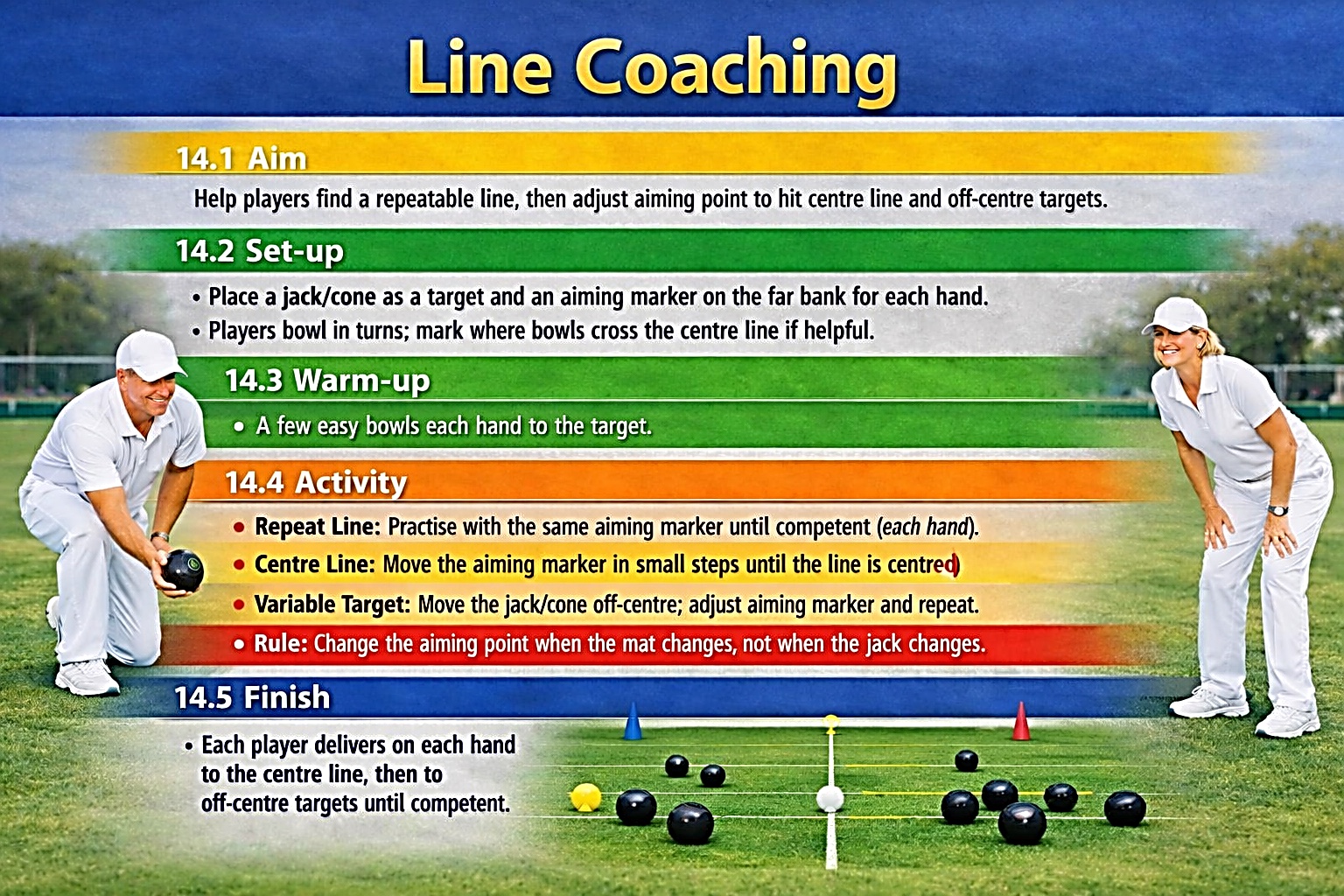
To teach the bowler to find a repeatable line and adjust the aiming point for the centre line and off-centre targets.
“Working on line has really helped me understand where to aim instead of just hoping for the best.”
Set-up
Set up the rink as described in the Aeroplane Method delivery session.
Warm-up
- Carry out a brief safety check, ensuring the rink is clear, footwear is suitable, and there is adequate space behind the mat.
- Include a warm-up at the start of every session and a cool-down at the end.
Activity
- Ask the bowler to deliver a bowl using the method previously taught and aim at the cone at the far end.
- Position yourself so that you can observe any faults in line delivery and help the bowler correct them throughout the session.
- After four bowls, visit the head and assess the spread across the rink, rather than the length, to judge how repeatable the line is.
Practise this on both forehand and backhand until the bowler can consistently deliver four bowls within a two-pace spread. At this stage, the group will not necessarily be on the centre line.
Moving the Group to the Centre Line
- Show the bowler where the centre of the group is and ask how they would move that group onto the rink’s centre line. They should identify that the aiming point needs to move.
- Ask the bowler to move the cone to the point they need to aim at, then allow them to bowl towards it.
- If their understanding of where to move the aiming point is not yet secure, guide them appropriately.
- Allow them to keep adjusting the cone until the bowls are delivered onto the centre line.
- Practise on both forehand and backhand.
Changing the Aiming Point
Explain that the aiming point does not change when the jack length changes, provided it remains on the centre line. Also explain that the aiming point does change when the mat is moved forward.
Finish
- By the end of the session, each player should be able to deliver on both hands to the centre line and to off-centre targets with consistency.
5. Length Control
Aim
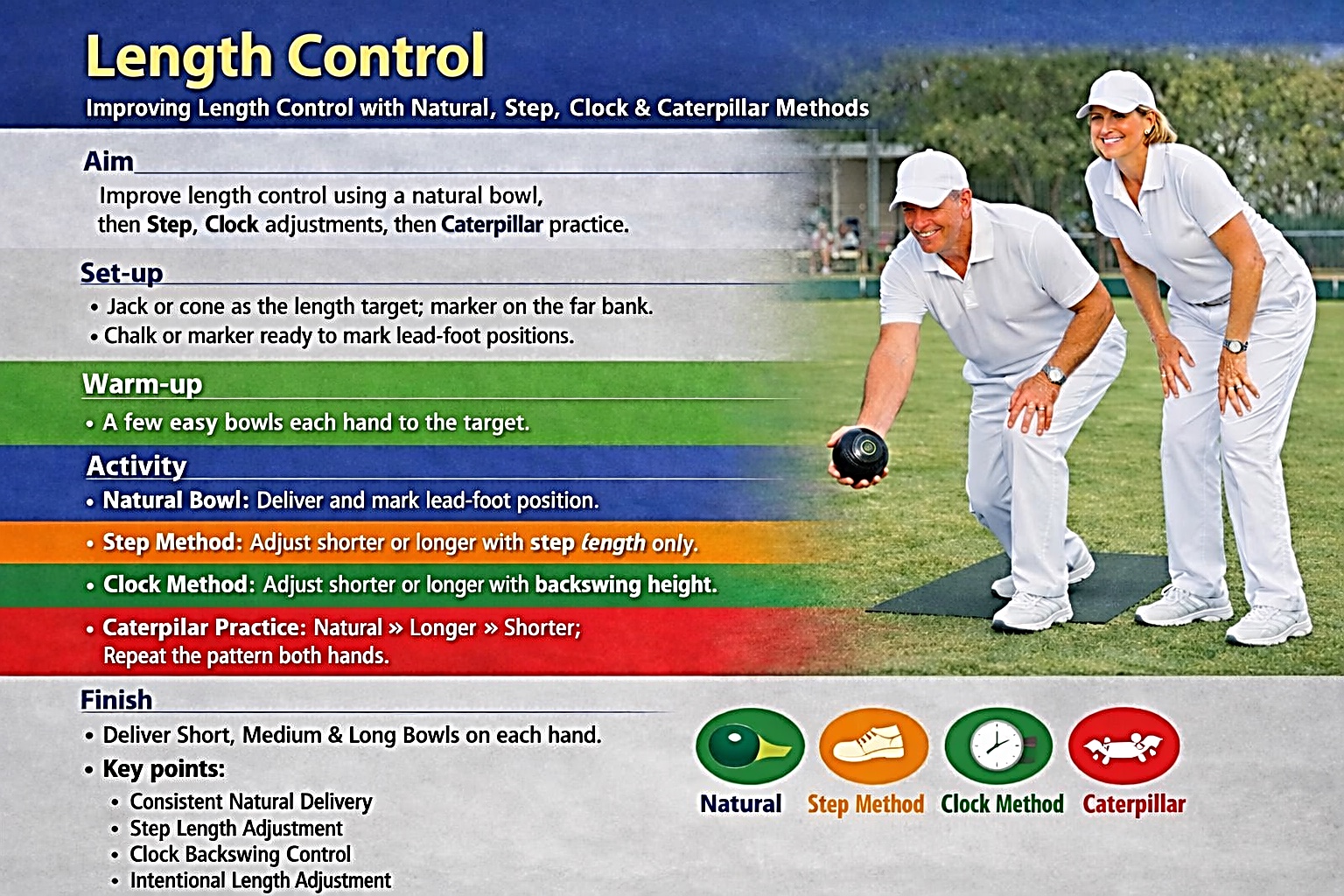
To teach the bowler to control length using a natural bowl, Step and Clock adjustments, and Caterpillar practice.
“The length drills made a huge difference — the Step and Clock methods finally gave me control, not guesswork.”
Set-up
- Set up the rink as described in the previous sessions.
- Have a marker ready to mark lead-foot positions.
Warm-up
- A few easy bowls each hand to the target.
Activity
- Natural bowl: begin by identifying the bowler’s normal delivery with no deliberate change to step or swing. Ask them to deliver several bowls to a medium target on each hand and mark the lead-foot position so they can see their own repeatable base. This becomes the reference point for all later length adjustments.
- Step method: adjust shorter or longer by changing the step length only, while keeping the same rhythm, arm speed, and follow-through. A slightly shorter step will usually reduce length, while a slightly longer step will usually add length. Encourage the bowler to make small changes and compare the result with their natural bowl.
- Clock method: adjust shorter or longer by changing the backswing height while keeping the same line, stance, and step length. Use the idea of a clock face to help the bowler picture the swing height—lower for shorter bowls and higher for longer bowls. The key coaching point is to change one thing only so the bowler learns what affects weight.
- Caterpillar practice: use a sequence of natural, longer, and then shorter bowls, repeating the pattern on both hands. This helps the bowler develop the ability to change length without losing line. Between deliveries, use simple questions such as “What did you change?” and “Was that enough?” so the bowler learns to recognise and repeat successful adjustments.
“Caterpillar practice has been brilliant; it forces me to think about both line and length together without overthinking.”
Finish
- By the end of the session, each player should be able to deliver short, medium, and long bowls on both hands using the Step and Clock methods with consistency.
6. Jack Delivery
Aim
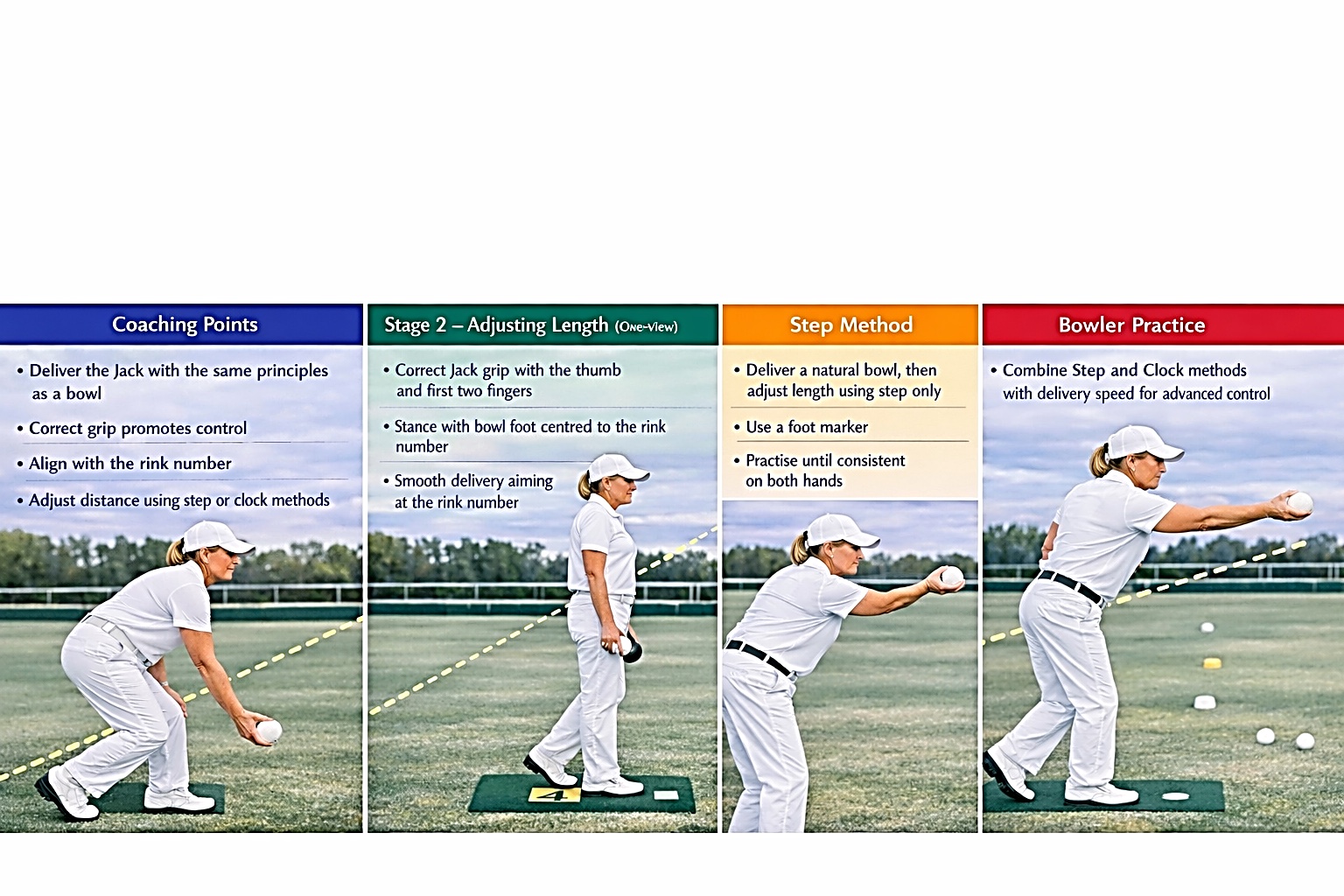
To teach a consistent jack delivery using the same line-and-length routine as a bowl.
“Using the same routine for jack delivery and bowls has made everything feel calmer and more consistent.”
Set-up
- One mat, jacks, and three length markers (short, medium, and long).
- Safety: ensure delivery area is clear; keep equipment away from the mat.
Warm-up
- A few easy jack rolls to the rink number for each player.
Activity
- Coach demonstration: show the same calm routine used for bowl delivery—check the line, stand balanced on the mat, look at the target, and release the jack with a smooth arm action and controlled follow-through. Emphasise that the jack has no bias, so it should travel where the body and hand direct it.
- Legal and straight: ask players to deliver the jack beyond the minimum legal distance and as near the centre line as possible. Keep the focus on a straight arm path, a steady head, and a balanced finish rather than force. If the jack runs off line, use simple questions such as “Where were you aiming?” and “Did your hand finish at the target?”
- Technique practice: ask each player to deliver a series of jacks to a medium length first. Once the line is repeatable, introduce short and long targets. Encourage one change at a time—either a small step adjustment or a small swing-height adjustment—so the player learns what affects length without losing line.
- Link to bowls: after each jack, ask the player to deliver a bowl using the same line-and-length routine. This reinforces the Level 1 principle that jack delivery and bowl delivery should feel connected, simple, and repeatable.
- Coach observation: watch for rushed set-up, looking down too early, falling away from the line, or trying to throw the jack. Correct only one point at a time and allow the player to try again straight away.
Finish
- By the end of the session, each player should be able to deliver short, medium, and long jacks with a legal, controlled, and repeatable routine.
- Quick recap: clear target, balanced stance, smooth release, controlled follow-through, and small adjustments for length.
- Finish by asking the player what helped them keep the jack straight and what change helped them alter the length. This keeps the session player-centred and reinforces learning through reflection.
Summary
Thank you for taking the time to read this booklet and, most importantly, for putting it into practice on the rink. Your coaching plays a central role in developing confident bowlers and building a strong, shared identity for our sport. By following this coaching system, clubs and coaches can support the wider EBCS national coaching structure and help create a more consistent pathway for introducing and developing new bowlers. Once these core basics have been taught and understood, coaches are encouraged to build on them and continue coaching using any practices, exercises, or session ideas that best suit their players, club environment, and coaching style. The aim is not to limit good coaching, but to provide a strong and reliable starting point from which coaches can work with confidence, flexibility, and creativity. We look forward to seeing these Level 1 practices embedded across our clubs and to supporting coaches as they continue to develop bowlers through safe, effective, and enjoyable sessions.
Questions about the new Level 1 practices? Email [email protected].